
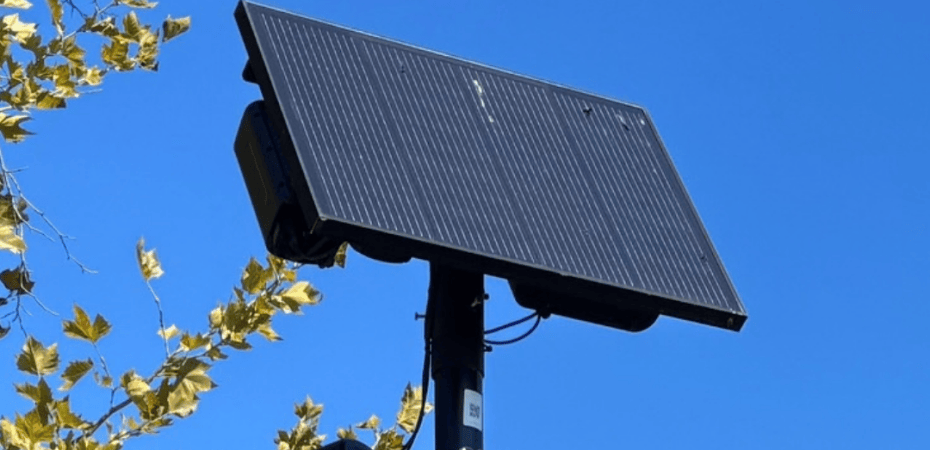
For local law enforcement, the five Flock cameras positioned around town have become an important tool for solving cases. The automated license-plate reader system has been in use locally since 2022.
Since then, Kernersville Police Chief Jason Tilley told Scope News, the technology has been directly attributed to closing 298 cases: 67 involving missing or wanted people and 238 investigations.
But as Flock cameras become increasingly common, they have also become the subject of a broader debate over privacy and surveillance. The American Civil Liberties Union of North Carolina argues that the technology can create a record of where vehicles (and potentially the people in them) have been over time.
Flock Safety, the company behind Kernersville’s system, says that characterization goes too far. And KPD says the system is considerably more limited in its scope than much of the public discourse on the matter would suggest.
What those cameras can see
Flock cameras capture still images of vehicles traveling on public roadways. The company says its system records plate numbers and certain characteristics such as vehicle make, color, and distinguishing features. It does not use facial recognition and does not identify occupants of vehicles.
The information is retained by Kernersville for 30 days, Tilley said, and “can only be accessed for investigative purposes.”
KPD investigators told us that they only access the database when they have a legitimate investigative reason to do so, and Flock noted that every search requires documentation. Searches generate permanent audit records showing when, why, and by whom they were made.
Flock also emphasized that its cameras do not provide a “live-tracking system,” pointing to dozens of courts across the nation that have determined its license-plate readers do not violate the Fourth Amendment or allow police to seamlessly track an individual’s movements.
Law enforcement makes the case
Kernersville police point to specific cases they say could have only been solved with the use of Flock cameras. One such investigation involved a missing 15-year-old, one investigator said, adding that an image of the vehicle involved was traced to New York based on distinguishing characteristics including body damage and stickers.
Tilley stressed that these are the kinds of cases that illustrate the technology’s value. He said officers can also create a “hot list” of vehicles of particular investigative interest, emphasizing that its use is highly selective.
Private businesses and residential communities can also operate Flock cameras, but police can only access that data when the private customer has opted to share it with the department.
KPD can also allow another law-enforcement agency to access its data when that agency is conducting an investigation that could lead into Kernersville’s jurisdiction, and vice versa. That sharing capability is not only one of the strengths highlighted by police, but one of the top concerns of privacy advocates.
The ACLU pushes back
Zac Contreras, a spokesperson for the ACLU of North Carolina, argues that focusing solely on license plate data diminishes the true extent of what automated license-plate readers can reveal.
“ALPRs like Flock are capable of reconstructing a vehicle’s movements over time,” he told us, adding that privacy concerns “are compounded when data from multiple surveillance technologies are integrated into a single platform.”
Of course, Flock disputes the characterization of its system as a tool for tracking the movements of individuals. But the ACLU’s position is clear.
Asked whether collected data can be used to create a searchable database of a person’s whereabouts, Contreras said: “This is not a concern; it is a proven fact.”
Does it make communities safer?
The answer to this question probably depends on who you ask.
KPD’s experience suggests the cameras have been useful, with Flock data cited as a factor in solving an array of criminal investigations, searches, and other cases.
Meanwhile, the ACLU maintains that even the most compelling anecdotes don’t necessarily translate to safer streets. Contreras pointed to recent FBI analysis from Atlanta, where a network of more than 28,000 integrated cameras has not meaningfully improved the city’s crime-clearance rates.
He also cited North Carolina’s ALPR pilot program and an associated report from the State Bureau of Investigations. Three Raleigh police cameras scanned more than 14.8 million license plates and produced 956 “hits” in law-enforcement databases — or approximately one hit for every 15,000 scans.
The SBI report does not establish how many of those hits resulted in an arrest, rescue, vehicle recovery, or other meaningful resolution. In any case, the ACLU argues that communities shouldn’t accept broad surveillance powers based solely on claims that it will help solve crimes.
Here in Kernersville, however, police say license-plate scanners serve a very narrow purpose with layers of safeguards in place to prevent the misuse of data.
Who’s policing the police?
Tilley explained that the town conducts both automated and manual audits of Flock use every 30 days. The system maintains a trail of searches and the department adheres to best practices established by the SBI.
He added that if the town manager wanted to review KPD’s use of the system, he could access it.
Flock similarly asserts that its technology is designed to make misuse difficult to conceal. The company announced that its Audit Assistance tool will be required for all law-enforcement agencies by the end of this year and it is also implementing a proactive lockout feature that can automatically suspend access based on the detection of abnormal behavior.
The ACLU, on the other hand, doesn’t believe these safeguards are sufficient and urges communities to be actively involved in deciding how surveillance technology is being used.
“We reject the idea that communities should accept blatant violations of their privacy rights based on an unsupported claim that ALPRs solve crime faster,” Contreras said.
North Carolina’s changing rules
State law permits ALPR data to be retained for up to 90 days in certain circumstances and requires agencies to establish written policies governing their use of the technology. The ACLU maintains that those protections are only as good as an individual agency’s willingness to implement them.
But Kernersville’s 30-day retention period is just one-third the state-mandated maximum. And Tilley pointed to another aspect of the local system that stops short of what North Carolina law permits.
When Kernersville began using Flock four years ago, cameras could not be placed on North Carolina Department of Transportation rights-of-way under the rules of the SBI-led pilot program. Those rules have since changed, but none of the cameras currently in operation by KPD are located on NCDOT property.
Final thoughts
There’s no shortage of surveillance technology in modern society. And while Tilley acknowledged that some residents are uncomfortable with the idea that their license plates can be photographed while traveling through town, he says Flock represents a relatively narrow form of surveillance compared with information gathered by other technologies people encounter every day.
“I would tell the concerned citizens that this tool is not as invasive as is being advertised in the media,” he said.
Cellphones, security systems, and doorbell cameras are among the examples Tilley cited as technologies that can reveal considerably more about an individual’s movements.
On a national scale, however, the ACLU maintains that the capabilities of ALPRs constitute a clear threat to civil liberties, regardless of whether a particular agency is using the technology to its full potential.
Contreras pointed us to a statement from Senior Policy Counsel Chad Marlow on the matter, as delivered last month to the U.S. Senate Committee on the Judiciary Subcommittee on Crime and Counterterrorism.
“When asked how to close the ‘loopholes’ in ALPR systems that allow for law enforcement abuse and misuse, Chad’s answer was simple: ban them,” he said.
Read Marlow’s full statement here.
In Kernersville, police clearly see Flock cameras as a tool that has helped them solve hundreds of cases. And Tilley says policies like regular audits from a non-sworn officer and a 30-day data-retention period provide important safeguards against misuse.
The ongoing debate in Kernersville and countless other communities goes much deeper than the cameras themselves. It’s about what the technology behind them is capable of doing — and to what extent a community is willing to embrace those capabilities for the sake of safety.
Copyright 2026 Informed Media Group LLC. All rights reserved. This material may not be published, broadcast, rewritten, or redistributed without express written consent.

