
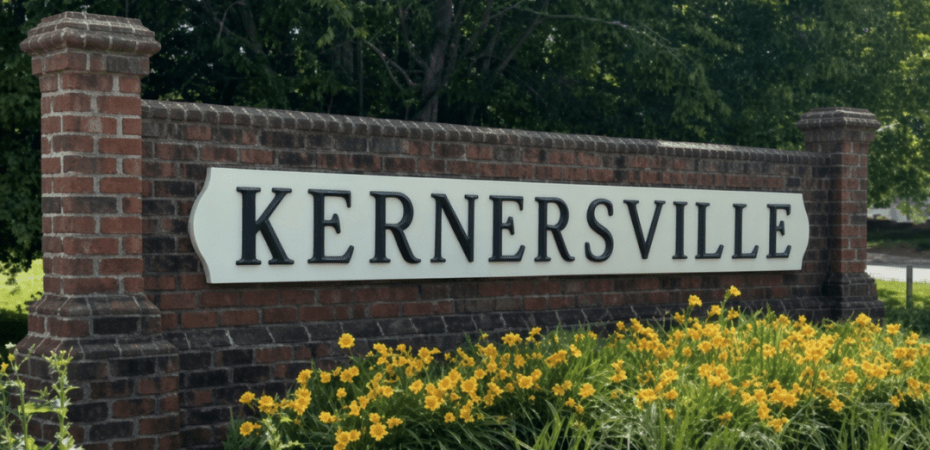
To start with the obvious, Kernersville is growing. Traffic and construction is everywhere and, for better or worse, the town is changing.
For the past two years, town leaders have been working on a detailed project designed to serve as a sort of roadmap to guide decisions about growth over the next decade or so.
The Kernersville Comprehensive Plan is nearing its final phase with a review by the Board of Aldermen set for later this month. The Planning Board approved the document at its latest meeting.
Community Development Director Catherine Garner spoke to Scope News about the plan and why it’s more important than many residents might realize.
“State law requires that we have a comprehensive plan in order to have zoning,” she explained. “You have to have a plan and you have to keep it reasonably updated in order to legally have zoning.”
The town’s previous plan dates back more than a decade and, while it has been updated over the years to reflect rezoning, Garner said Kernersville has changed too much for piecemeal updates to suffice.
One of the biggest misconceptions, she noted, is that Town Hall can dictate whether or not Kernersville’s growth continues. Sitting in the middle of one of the state’s fastest-growing metro areas means this community will be impacted.
“To expect that we wouldn’t be growing in the middle of all of the growth is sometimes unrealistic,” Garner said. “We’re feeling a lot of the impacts of the growth that’s happening even just outside us.”
The Comprehensive Plan was designed to reflect that reality.
Beginning last year, town staff and consultants spoke to civic groups, held town halls, and met residents at several popular local events, including the Spring Folly, Juneteenth, and the Honeybee Festival. Their goal was to determine what locals want Kernersville to look like, and the answers were largely consistent.
Garner paraphrased the general consensus: “We love Kernersville. We love it. It feels like a small town. We know that growth is happening, but we don’t want it to lose its character in the process.”
The major concerns, she said, fell into two categories: preserving our hometown character and addressing transportation-related issues.
One interesting exchange during our interview centered on what residents really mean when they say they don’t want Kernersville to “change.”
Garner argued that preserving a community doesn’t mean freezing it in time, adding: “When people talk about the small-town feel of Kernersville, they’re not necessarily talking about it as a small-town place. They’re talking about the feeling that they have in the community, that they know their neighbors.”
Change is not only inevitable, but it’s nothing new for Kernersville. Healthcare facilities, major retailers, and much of the development across town didn’t exist a generation ago.
Going forward, Garner says the challenge lies in deciding which parts of Kernersville are integral to its identity.
“It’s all a balance and a trade-off,” she said. “What do we want and what are we willing to prioritize in order to maintain that which we want?’
Unlike the town’s current planning documents, the new Comprehensive Plan combines a wide range of subjects into a single document. Instead of focusing primarily on land use and development, it also addresses things like transportation, housing, economic development, downtown improvements, environmental planning, parks and recreation, and quality of life.
The purposely broad “quality of life” category, Garner explained, “covers things like downtown amenities, sidewalks, benches, art — all of the things that people don’t necessarily think of being important to plan for.”
One proposal that stands out involves encouraging more small-scale, mixed-use development, which Gardner said is designed to reduce traffic and shorten everyday trips.
“If you’ve got smaller pockets where people can get to what they need closer to their house, then you’re alleviating the traffic in some of the other areas,” she said.
Beyond what the Comprehensive Plan is, Garner was also clear about what it isn’t. She encouraged residents to view it as a guide, not a guarantee, and advised that it will continue to evolve as necessary.
“This is realistically a 10-to-15-year plan, but it’ll probably be a seven-to-10-year plan,” she added.
Even locals with no interest in zoning maps or planning documents will likely be affected by this plan, since it influences how neighborhoods grow, which transportation improvements are prioritized, and what public projects the town invests in.
“Don’t live in a vacuum,” Garner said. “We want to engage with you. That’s why most of us are in local government.”
Residents can review the entire document here. The Board of Aldermen will meet August 26 for final consideration.
Copyright 2026 Informed Media Group LLC. All rights reserved. This material may not be published, broadcast, rewritten, or redistributed without express written consent.


[…] document intended to guide development, transportation, infrastructure, and land-use decisions, click here for our more in-depth […]
LikeLike
[…] RELATED | Kernersville’s New Comprehensive Plan: What It Is And Why It Matters […]
LikeLike